
Steel Shot Testing: Hardness, Microstructure & Durability
Learn how hardness (HRC), microstructure and quality testing influence steel shot durability, impact resistance and blasting performance. Discover key testing methods and technical specifications to select the right steel shot for industrial applications.
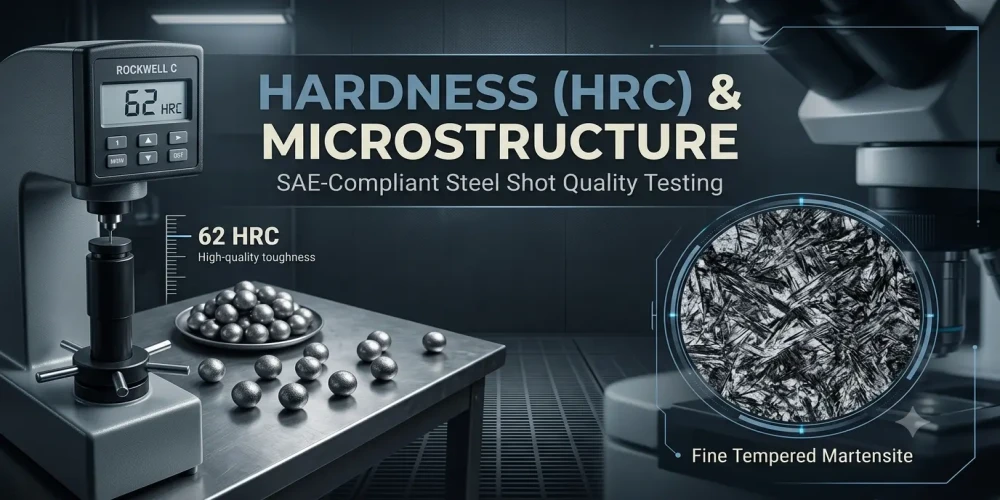
Steel Shot Testing: Understanding Hardness and Durability
Have you ever wondered why some steel shots deliver consistent blasting performance while others break down quickly during operation? The difference often lies in their hardness (HRC) and internal microstructure in steel shots These two properties play a critical role in determining the strength, toughness, impact resistance and service life of steel shot. During industrial abrasive blasting, even small variations in material quality can affect cleaning efficiency, abrasive consumption and overall operating costs. Understanding how hardness and microstructure are tested helps manufacturers maintain product consistency and enables industrial buyers to choose the right steel shot for reliable surface preparation.
What Is Hardness (HRC) in Steel Shot?
Hardness refers to the ability of steel shot to resist indentation, deformation and surface damage during blasting operations. Rockwell Hardness (HRC) is a commonly recognised hardness scale used for suitable hardened steel materials.
In steel shot manufacturing, hardness is an important quality parameter because it directly influences impact performance and abrasive durability. If hardness is too low, steel shot may deform during repeated impacts. If hardness is excessively high, particles may become brittle and break into smaller pieces.
Maintaining the correct hardness range helps achieve consistent blasting performance, controlled abrasive consumption and reliable surface preparation.
Importance of Steel Shot Hardness Testing
Steel shot hardness testing helps manufacturers maintain consistent product quality across different production batches. It also allows industrial buyers to evaluate whether the abrasive meets their application requirements.
The major benefits include:
- Improved durability: Suitable hardness helps steel shot withstand repeated impact.
- Consistent cleaning performance: Uniform hardness supports predictable surface preparation.
- Reduced abrasive consumption: Durable particles can remain usable for more recycling cycles.
- Better quality control: Hardness testing helps identify variations during manufacturing.
- Reliable blasting results: Consistent abrasive properties improve process stability.
Hardness should always be evaluated along with toughness and microstructure rather than being considered independently.
Understanding Microstructure in Steel Shot
Microstructure refers to the internal arrangement of phases and grains within steel. It can be examined using a metallurgical microscope after preparing and polishing a suitable sample.
For quality steel shot, a uniform tempered martensitic microstructure is generally preferred because it provides a balance between hardness, strength and toughness.
An inconsistent microstructure may indicate problems during heat treatment or manufacturing. These variations can affect particle strength, impact resistance and service life.
Microstructure examination helps manufacturers identify internal defects, uneven heat treatment and unwanted structural variations that may reduce abrasive performance.
Role of Heat Treatment in Steel Shot Quality
Heat treatment is an important manufacturing process that influences the hardness and microstructure of cast steel shot. It generally involves controlled heating, quenching and tempering to achieve the required mechanical properties.
- Heating: Steel shot is heated to a controlled temperature to develop the required metallurgical structure.
- Quenching: Rapid cooling transforms the steel structure and increases hardness.
- Tempering: Controlled reheating reduces excessive brittleness and improves toughness.
Proper heat treatment helps produce steel shot with balanced hardness, uniform microstructure and improved resistance to repeated impact.
How Is Steel Shot Quality Testing Performed?
Steel shot quality testing involves multiple inspection methods to verify its physical and metallurgical properties.
1. Hardness Testing
A suitable hardness testing method is used to measure the resistance of steel shot to indentation. Because individual particles are small, specimen preparation and appropriate testing procedures are important for obtaining reliable HRC readings. Unlike steel shot, glass beads are typically evaluated for hardness using the Mohs scale or other suitable material testing methods, depending on the application and testing requirements.
2. Microstructure Examination
A polished and etched metallurgical sample is examined under a microscope. This process helps identify the steel structure, uniformity and possible manufacturing defects.
3. Particle Size and Shape Analysis
Steel shot particles are inspected for size consistency and roundness. Uniform particle dimensions help maintain predictable abrasive flow and blasting coverage.
4. Internal Defect Inspection
Particles are examined for cracks, voids and other internal defects that can cause premature breakage during blasting operations.
5. Durability and Performance Evaluation
Steel shot is evaluated for resistance to repeated impact and breakdown. This helps estimate its suitability for abrasive recycling and industrial blasting applications.
Note: These are indicative technical details. Actual specifications depend on the steel shot grade, manufacturing process and manufacturer's product data. Hardness and density values should be verified through the relevant technical datasheet and test report.
Relationship Between Hardness, Microstructure and Steel Shot Performance
Hardness and microstructure work together to determine the overall performance of steel shot.
|
Quality Parameter |
Effect on Steel Shot |
|
Proper hardness |
Supports impact resistance and durability |
|
Excessive hardness |
May increase brittleness |
|
Low hardness |
May cause faster deformation |
|
Uniform microstructure |
Improves consistency and reliability |
|
Poor microstructure |
May increase cracking and particle breakdown |
A balanced combination of hardness and microstructure helps maintain abrasive efficiency and reduce unnecessary material replacement.
Steel Shot Technical Specifications
Understanding the technical specifications of steel shot helps industrial buyers evaluate its hardness, microstructure, particle consistency and suitability for different abrasive blasting applications.
|
Specification |
Details |
Importance |
|
Material |
High Carbon Steel |
Provides strength and durability |
|
Hardness (HRC) |
40–60 HRC (grade dependent) |
Determines resistance to deformation and impact |
|
Microstructure |
Tempered Martensite |
Supports hardness and toughness |
|
Particle Shape |
Spherical / Round |
Ensures consistent blasting action |
|
Particle Size |
S170–S930 (depending on application) |
Determines surface coverage and impact intensity |
|
Density |
Approx. 7.0–7.8 g/cm³ |
Influences impact energy |
|
Manufacturing Process |
Melting, atomisation, heat treatment and screening |
Helps maintain particle quality |
|
Quality Testing |
Hardness, microstructure, size and durability testing |
Ensures product consistency |
|
Applications |
Foundries, automotive, shipbuilding and steel fabrication |
Supports industrial surface preparation |
Why Steel Shot Quality Testing Matters in Industrial Blasting
Steel shot is widely used in foundries, automotive manufacturing, steel fabrication, shipbuilding and heavy engineering industries.
In these applications, inconsistent abrasive quality can increase operating costs, reduce cleaning efficiency and create additional maintenance requirements.
Regular quality testing helps manufacturers maintain production standards while allowing buyers to compare abrasive specifications before purchasing. It also supports better selection of steel shot for different shot blasting machine and surface preparation requirements.
How to Choose Quality Steel Shot for Industrial Applications
Before purchasing steel shot, industrial buyers should consider the following factors:
- Check the specified hardness range and testing method.
- Verify microstructure uniformity.
- Review particle size and shape specifications.
- Ask for quality inspection and test reports.
- Consider abrasive durability and recycling performance.
- Select the appropriate steel shot grade for the blasting application.
Buyers should also verify product specifications with the manufacturer to ensure compatibility with their equipment and operational requirements.
Conclusion
Understanding steel shot technical specifications is essential for selecting the right abrasive media, aluminum oxide for industrial blasting applications. Parameters such as hardness, microstructure, particle size, shape and density directly influence blasting efficiency, durability and surface preparation quality. Proper quality testing and manufacturing control help ensure consistent abrasive performance and reduce unnecessary material consumption. Before purchasing steel shot, industrial buyers should verify technical specifications, review quality test reports and select the appropriate grade according to their machine requirements and application needs. This helps achieve reliable blasting results, improved productivity and long-term operational efficiency.
You may also like
 Steel Shots
How Many Times Can Steel Shot Be Reused?
Discover how many times steel shot can be reused in shot blasting machines. Learn about steel shot recycling cycles, abrasive recovery systems, factors affecting lifespan, and tips to reduce industrial blasting costs.
Read Article Steel Shots
Top 5 Applications of Steel Shots
Steel shots refer to the steel molecules that are generally used in the shot blasting and peening process as an abrasive in removing unwanted substances from the metal surfaces.
Read Article Steel Shots
Steel shot s390 specification and Price in India
Steel shot S390 is a type of high-quality steel shot used primarily in industrial applications such as surface preparation shot peening and cleaning.
Read Article